Hyderabad is now the most expensive metro city in India to fill up with petrol and diesel, which adds financial pressure to daily commuters, transport operators, and businesses alike. As such, the rising petrol and diesel prices have raised further questions surrounding state taxes, inflation, and the entire cost of living in the capital of Telangana.
Here’s a quick summary of what you need to know about the current price of fuel in Hyderabad.
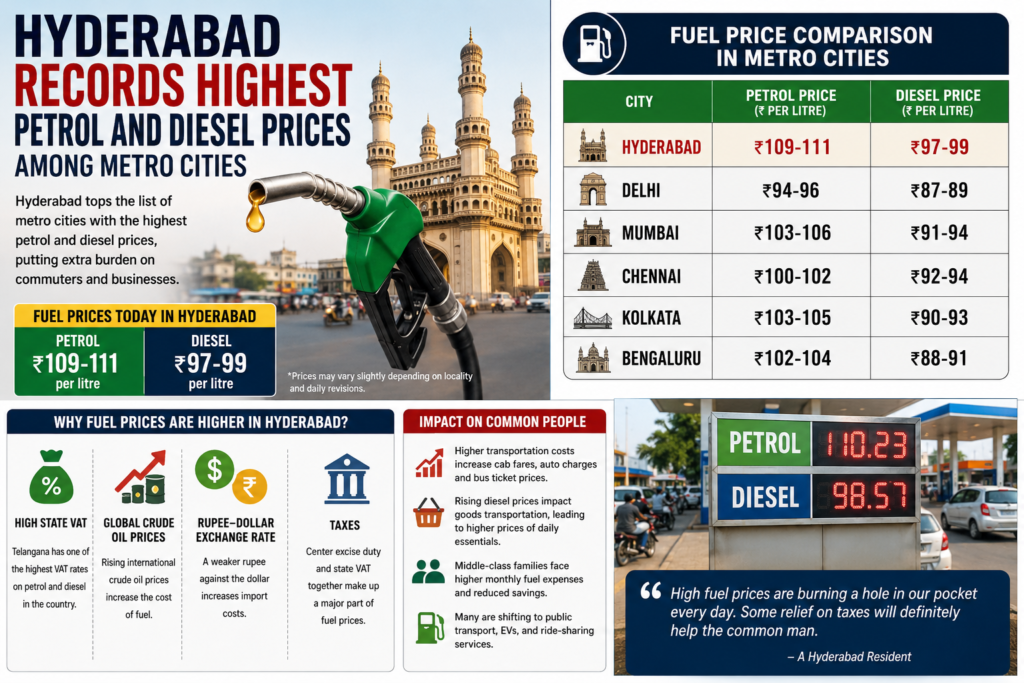
Table of Contents
Hyderabad Fuel Prices Today
As per the latest fuel price revision:
| Fuel Type | Hyderabad Price |
| Petrol Price | Around ₹109–₹111 per litre |
| Diesel Price | Around ₹97–₹99 per litre |
These rates make Hyderabad costlier than other major metro cities, including Delhi, Mumbai, Chennai, Bengaluru, and Kolkata.
Why Are Fuel Prices Higher in Hyderabad?
A number of factors contribute to petrol and diesel being the most expensive of any metro city in India, including Hyderabad.
1. State VAT
The biggest factor is the high VAT imposed by the state of Telangana on fuel. Each individual state imposes taxes on petrol and diesel separately, and the VAT rates in Telangana are amongst the highest in the country.
The total cost to a consumer for petrol or diesel in India is broken down as follows:
- Base price of the fuel
- Central excise duty
- Dealer commission
- State VAT
The higher the VAT, the higher the retail price paid by the consumer.
2. Global Crude Oil Prices
Both domestic prices of fuel in India are greatly impacted by international crude oil prices. Each time international crude oil prices increase, Indian oil companies will revise the price of petrol and diesel.
The main reasons why international crude oil prices have altered include:
- Russia-Ukraine War
- America-Israel-Iran war
- OPEC production cuts
- Global supply disruptions
- Currency fluctuations
3. Rupee-Dollar Exchange Rate
The majority of India’s crude oil is imported. Fluctuations in the value of the Indian rupee compared to the U.S. dollar result in an increase in the local cost of imported fuel, which in turn causes an overall increase in the cost of retail fuel.
4. Transportation and Dealer Costs
Other factors that affect the cost of fuel locally include logistics, transportation charges, and dealer commissions. The demand for and the quality of urban transportation infrastructure in metropolitan cities such as Hyderabad can have incremental effects on the ultimate retail price of fuel.
Comparison With Other Metro Cities
Here’s how Hyderabad compares with other Indian metro cities:
| City | Petrol Price | Diesel Price |
| Hyderabad | ₹109–₹111 | ₹97–₹99 |
| Delhi | ₹94–₹96 | ₹87–₹89 |
| Mumbai | ₹103–₹106 | ₹91–₹94 |
| Chennai | ₹100–₹102 | ₹92–₹94 |
| Kolkata | ₹103–₹105 | ₹90–₹93 |
| Bengaluru | ₹102–₹104 | ₹88–₹91 |
Prices may vary slightly depending on locality and daily revisions.
Impact on Common People
Increased Transportation Costs
Higher prices for fuel increase the cost of providing services such as the following:
- A cab fare.
- An auto-rickshaw fare.
- Bus operating costs.
- Goods transport costs.
The increased cost of transportation will subsequently raise the price of food items and other essential goods and services.
Rising Inflation
Fuel prices affect inflation rates because almost every sector of the economy is thus directly related to transportation costs, and especially the price of diesel fuel has a significant effect on transportation logistics and supply chain operations.
Burden on Middle-Class Families
Commuters who own their own vehicles are incurring an increasing amount in related travel costs every month; consequently, increasing numbers of residents are
- Taking public transit.
- Buying electric vehicles.
- Utilizing ride-sharing services.
- Reducing travel.
Telangana Government’s Stand
The Telangana state government has frequently attracted criticism for fuel taxes levied on its citizens. Opposition parties have consistently called for reductions in the VAT component of the fuel tax as a means to provide relief to citizens.
However, as state governments are heavily dependent on revenue generated from fuel taxes, reducing fuel taxes creates a substantial burden on the ability of state governments to generate operating revenue.
Central Government’s Role
The Union government also imposes excise duties on fuel. Although excise cuts were announced in previous years, many experts believe further reductions could help stabilize prices.
Fuel pricing in India was deregulated in 2010 for petrol and 2014 for diesel, meaning oil companies now revise rates based on market conditions.
Are Fuel Prices Revised Daily?
Yes. Oil marketing companies such as
- Indian Oil
- Bharat Petroleum (BPCL)
- Hindustan Petroleum (HPCL)
Revise fuel prices every day based on international crude prices and currency exchange rates.
Prices are usually updated every morning.
Public Reaction in Hyderabad
The sharp fuel prices have triggered mixed reactions among residents.
Many commuters have expressed concerns over the following:
- Increasing monthly fuel expenses
- Costlier deliveries and services
- Impact on small businesses
- Reduced savings
Social media users have also debated whether state tax reductions could help provide immediate relief.
Growing Shift Toward Electric Vehicles
The rise in petrol and diesel prices is accelerating Hyderabad’s EV adoption.
Consumers are increasingly purchasing:
- Electric scooters
- Electric cars
- Hybrid vehicles
The Telangana government has also introduced EV-friendly policies to encourage sustainable transportation.
Experts’ Opinions
There are four reasons for the high volatility in gas prices, according to economic analysts around the world:
- Tensions in the world related to government operations
- Cost of crude oil worldwide
- Dependency of countries on importing crude oil
- Fluctuating currency values.
Analysts feel that if India can develop its own crude independence and become more renewable resource-driven, the country can have an impact on the long-term cost of gasoline.
Conclusion
As of now, Hyderabad has the highest gas prices of the 5 largest cities in India. The following are the primary contributors to the overall price increase of gas:
- High excise tax rates
- Fluctuating costs of crude oil worldwide
- Fluctuating rates for foreign currency when importing crude.
Gas prices continue to have a negative impact nationally and globally on household budgets, transportation costs, inflation rates, and more. There are discussions about how we could lower our taxes and develop a renewable energy source to create a more sustainable mode of transportation, leaving people looking for ways to travel at an affordable cost.
Also read: Who Was Bharath Kanth? Kannada Actor Dies in Tragic Road Accident at 31
How Mobile Addiction Impacts Mental Health: A Silent Crisis Affecting Millions

1 thought on “Hyderabad Becomes India’s Most Expensive Metro City for Petrol and Diesel”